

Parking Loop Features and Functions
Parking Loop is a free color-sorting puzzle from Loop Games built around one idea: every car you release circles a single one-way ring until a matching column takes it. Its features are the pieces that make that idea harder over hundreds of levels, plus a typical free-to-play layer of coins, ads and bundles.
This is a fan-made guide. It is not affiliated with Loop Games.
Game facts
Developer and seller: Loop Games Oyun Teknolojileri Anonim Sirketi, presented as Loop Games. US App Store release: September 4, 2026. Platforms: iPhone and iPad with iOS or iPadOS 15.0 or later, and Apple silicon Macs; there is also a Google Play listing for Android with the package com.loop.packedloop. Price: free with in-app purchases and ads. The App Store page lists English as the app language and Board and Puzzle among its categories.
The store description promises simple and intuitive gameplay, satisfying mechanics, clever puzzles, colorful levels and hundreds of puzzles. Ratings on the US store were around 4.7 out of 5 from more than five thousand ratings when this guide was written, and those figures can change.
Core loop
The core loop is short and repeatable: read the lot, release a car, watch it circle, and complete a column. Each completion is a small payoff, with cars glowing and driving away. Because the ring always has the same shape, attention stays on order and timing rather than on learning a new map.
One reviewer criticized exactly this, saying the loop never changes and only the lanes, depth and colors vary. That is a fair description of the design: variety comes from pieces and pressure rather than geometry. If you enjoy optimization puzzles, the fixed ring is a strength because every lesson carries forward.
Board pieces
The store screenshots document the pieces that appear in the first sixty levels, and walkthrough videos show them returning later.
- Columns of varying depth, from short teaching stacks to five-deep stacks.
- Elevator lanes, usually two to four, that release the front car on tap.
- The ring badge, capped at five in the store images, with a red outline at the cap.
- Wrapped cars marked with question marks that hide their color.
- Sealed stacks that split into regular cars partway through.
- Cones and striped barriers that close side bays.
- Blue covers that seal lanes and can carry parked cars on top.
- Linked cars that leave together, adding two to the badge.
Difficulty progression
The first ten levels are tutorials that teach the loop. Levels 11 to 50 add five-column lots, wrapped cars and the first closed bays. The 50s add covers. Through the hundreds the same pieces are combined more densely. Walkthrough videos for levels in the 300s are still about a minute or two long, which suggests the difficulty comes from precise order rather than from very long boards.
Version history on the App Store shows frequent updates since launch, including a September 19 update that added a new obstacle. Layouts may therefore be revised over time.
Coins, ads and purchases
The US store lists purchases such as coin packs at several prices, beginner and welcome bundles, ladder and end-game offers, a pro pack and a remove-ads bundle. Ads are part of the free version. Reviews mention an ad option that moves cars into the queue when a level is stuck, and one review described an ad that glitched and required a restart.
This site does not sell anything in the game and does not list exact reward values, because the public store page does not publish them.
Events and modes
Player reviews mention recurring events, with one reviewer saying the same two events tend to repeat. The public store page does not describe them in detail, so this guide does not invent names or rewards. The main content is the numbered level path covered on this site.
Privacy notes from the store
According to the App Store privacy label, the app may use identifiers, usage data and advertising data to track users across apps and websites, and may collect diagnostics and other data. Check the developer’s privacy policy linked from the store for current details.
Presentation and controls
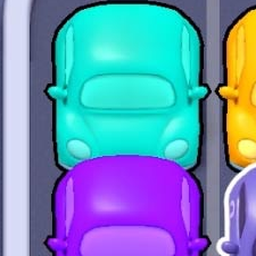
The art style is soft and toy-like: rounded cars in saturated colors, a grey road with dashed markings, grass verges with small flowers, and a large white level number at the top. The title screen in the store images shows a red car and a yellow car on a country road beneath bubbly lettering. Controls are a single tap on the front car of a lane; there is no dragging, swiping or rotating. That makes the game comfortable to play one-handed in portrait mode, and it also means the challenge is almost entirely mental.
Feedback is visual. A completing column glows and drives off, a car pushed out of a mouth rejoins the road with a small dust trail, and the ring outline turns red at the cap. Learning to notice those cues is the first step toward reading a board quickly.
Why players search for level guides
Because each board has a specific working order, one wrong release can make a level unwinnable without a retry. Hidden cars make some openings hard to plan. That is why numbered searches such as level 119, 199 or 349 are common, and why this site pairs every covered level with a video and written steps.